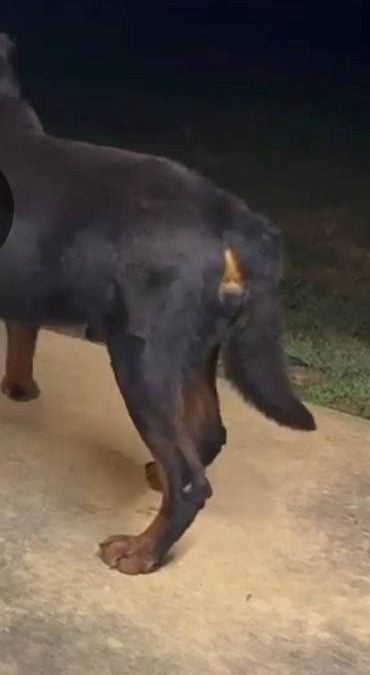
If you are looking for a Rottweiler with a docked tail, you have come to the wrong place. I want to be as clear as possible about this from the very beginning. I do not follow the American Kennel Club breed standards for tail docking. I absolutely will not dock tails on any puppy born at Von Z Max. This is a firm rule. It does not matter if you ask nicely or offer to pay more. Every single one of our dogs will keep their natural tail for their entire life. There are no exceptions to this policy.
This might surprise some people who grew up seeing Rottweilers with short little stumps. For a long time, that was the only way people saw this breed in the United States. But things are changing. I believe it is time to move past a tradition that does more harm than good. My goal is to raise healthy, happy, and functional dogs. Cutting off a piece of their spine for the sake of a "look" just does not fit into that mission.
Why the AKC Standard Does Not Rule Our Kennel
The American Kennel Club still lists a docked tail as part of the Rottweiler breed standard. Many people think that because the AKC says so, it must be the right way to do things. I disagree. The Rottweiler is a German breed. In Germany, the ADRK (Allgemeiner Deutscher Rottweiler-Klub) is the authority on the breed. Germany banned tail docking back in 1999. Since then, the most elite Rottweilers in the world have been shown and worked with their full, natural tails.
We specialize in imported German Rottweilers. It makes zero sense to me to take these incredible animals from a heritage that respects their natural form and then chop parts off to satisfy an outdated American fashion trend. We follow the German way of thinking because it prioritizes the integrity of the dog. You can see our commitment to these bloodlines on our About page.
The Reality of the Procedure
There is a common myth that tail docking is just a quick nip that puppies do not even feel. People say that because it is done when they are only a few days old, their nervous systems are not developed. This is simply not true. Scientific research has shown that puppies have a fully functioning nervous system at birth. They feel the pain of the amputation.
When a tail is docked, the breeder or a vet is cutting through skin, muscle, nerves, and bone. In most cases, this is done without any anesthesia. The puppies scream because it hurts. Even after the initial cut, there is a risk of developing neuromas. These are tangled bundles of nerve endings that can cause chronic pain for the rest of the dog's life. I am not willing to put a puppy through that kind of trauma for a cosmetic preference.
The American Veterinary Medical Association opposes cosmetic tail docking for this exact reason. They recognize that it is a painful procedure with no proven medical benefit for the vast majority of dogs. If the experts who dedicate their lives to animal health say it is unnecessary, I am going to listen to them.
A Tail is a Communication Tool
If you have ever watched a dog with a full tail, you know how much they use it to talk. Dogs do not have words, so they rely on body language. The tail is one of the most expressive parts of their body. It is not just about "happy" or "sad." A tail can signal confidence, curiosity, fear, or a warning.
When you remove the tail, you take away a huge part of a dog's ability to communicate with other dogs. This can lead to serious misunderstandings. A natural-tailed dog can clearly show another dog that they are not a threat by holding their tail in a specific way. A docked dog loses that nuance. Other dogs might misinterpret their stiff posture as aggression because the visual cue of the tail is missing.
This communication is also vital for the relationship between the dog and the owner. I want my clients to be able to read their dogs perfectly. A natural tail makes it much easier to know what your Rottweiler is thinking. Whether you are looking at our available males or females, you will notice how much personality comes through in their natural carriage.
Balance and Physical Health
The tail is an extension of the spine. It is there for a reason. When a Rottweiler is running, jumping, or turning at high speeds, they use their tail like a rudder. It helps them maintain balance and coordinate their movements. Removing it can affect their overall agility.
There are also concerns about how docking affects the muscles in the pelvic floor. The nerves and muscles that support the tail are connected to the muscles that support the bowels and bladder. Some studies suggest that docking might contribute to a higher risk of incontinence or perianal hernias later in life. While more research is always being done, it stands to reason that removing a functional part of the musculoskeletal system will have a ripple effect on the rest of the body.
We want our dogs to live long, active lives. We want them to be able to run in the yard and play without unnecessary physical limitations. Keeping the tail intact is a simple way to support their natural athletic ability.
The Myth of "Preventing Injury"
One of the oldest arguments for docking is that it prevents injuries. People claim that working dogs will hurt their tails on brush or in doors. While it is true that a tail injury can happen, it is very rare. Most Rottweilers today are family companions and guardians, not dogs living in extreme conditions where tail injury is a constant threat.
It does not make sense to amputate the tails of 100% of puppies to prevent a potential injury that might only happen to 1% of them. If a dog actually sustains a severe tail injury later in life, a vet can perform a medical amputation then. But doing it preemptively to healthy puppies is like a human getting their appendix removed "just in case" it might get infected one day. We prefer to leave healthy body parts alone.
A Global Perspective
The United States is one of the last few places where tail docking is still common. Most of the developed world has already moved on. Australia, the United Kingdom, and nearly all of Europe have banned or strictly restricted the practice. They recognized years ago that the welfare of the dog is more important than a traditional look.
At Von Z Max, we pride ourselves on being forward-thinking. We are not interested in doing things the way they have always been done just because of tradition. We want to be leaders in the breed. That means making choices that are best for the dogs, even if those choices are unpopular with some old-school breeders. Our reviews show that our owners appreciate the health and temperament of our dogs, tails and all.
Respecting the Whole Dog
When you bring a Von Z Max Rottweiler into your home, you are getting the whole dog. We believe these animals are beautiful exactly as they are born. The powerful build, the intelligent eyes, and yes, the long, thick tail are all part of the package.
I know that some people have a very specific image in their mind of what a Rottweiler should look like. If that image must include a docked tail, then I am not the breeder for you. I will never compromise my ethics for a sale. My responsibility is to the puppies I bring into this world. I owe it to them to give them the best start in life, and that starts with keeping them whole.
If you are a serious owner who values health, heritage, and the natural beauty of this breed, I would love to talk to you. You can learn more about our process and how to get on a waiting list on our How It Works page. But please, do not ask about the tail. The answer will always be no. We love our dogs too much to change them for a fashion statement.